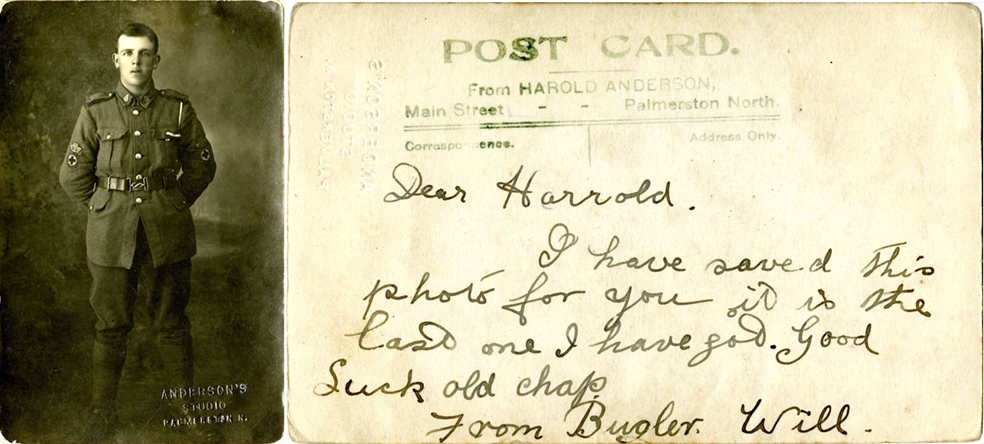
The Ian Matheson City Archives recently received the donation of a portrait postcard showing a First World War soldier, the photograph taken by Anderson’s Studio, Palmerston North.
We knew the postcard had previously belonged to Harold Vincent, who served with the Australian Navy during the war, as it had been carefully packaged and posted to the archives by his granddaughter in Western Australia.
However, all we had to identify the soldier depicted was the moniker “Bugler Will.”
During the First World War, the responsibilities of a Bugler included rousing the troops with reveille, last post and meal calls, together with delivering command signals during battle.
Initial research turned up multiple First World War buglers named William, many of them tragically killed in action as buglers were frequently targeted by snipers.
We chanced across a reference to “Bugler W. J. Philson” who was stationed at the Rangiotu Army Camp, near Palmerston North, in August 1915.
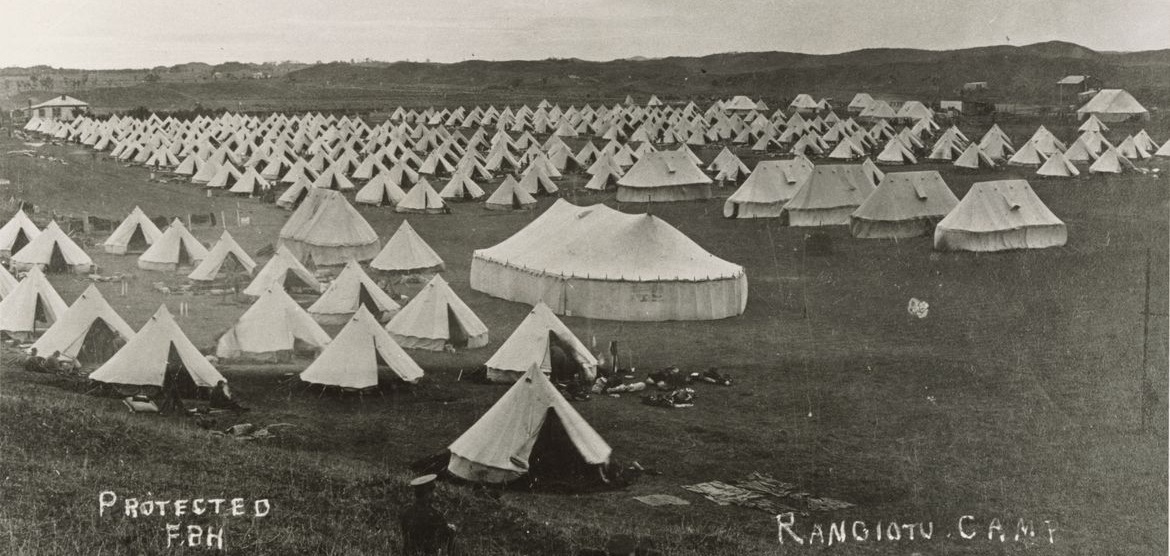
Additional research confirmed the “W” was for William. The Military Personnel File for William James Philson (1895-1975, service number, 12/2899) of Auckland, shows that he commenced service in April 1915 and served in Gallipoli and France before being discharged on 5 August 1919.
We are grateful that this memento of World War One has been returned to Palmerston North and doubly pleased that we have been able to rediscover Bugler Will’s probable name and identity.