Tell us about yourself.
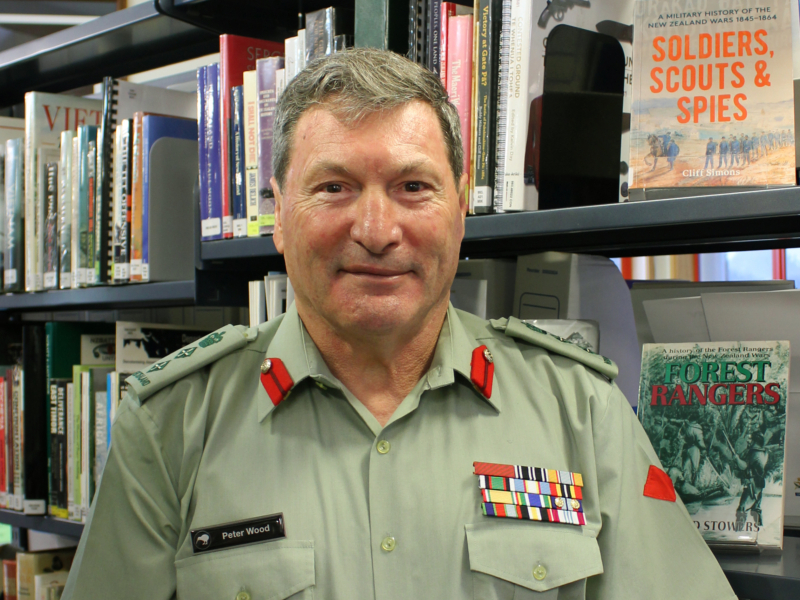
I retired from teaching military history at Massey University in 2021. I now live at Foxton Beach with my wife Susan; however, my two daughters still live in Palmerston North. Working at Massey University allowed me time to research and write and I have now had over 30 books published.
Where are you originally from?
I was born in Christchurch and lived many years at a place just north of the city called Pines Beach. I went to school at Kaiapoi High School for two years and then Mairehau High School when our family moved back to the city.
How long did you live in Palmerston North?
Just on 18 years from 2001 to 2018.
Where did you train?
There are two parts to this question: academic and military.
I completed an MA (Hons) at Canterbury University majoring in History and English followed by a Diploma of Teaching at Christchurch Teachers’ College. Some years later I did a PhD at the University of New England in Armidale, New South Wales.
My PhD thesis was about the New Zealand commander Major General Sir Howard Kippenberger, and it was later published as a book.
I received my initial military training as a soldier at Burnham Military Camp and my officer training in Australia at Kokoda Barracks, Canungra Military Base in Queensland.
Tell us about your career.
I have had four different careers during my working life. My first full time job was as a teller when we used to have the Post Office Savings Bank. I quickly realised that it wasn’t for me.
I then trained as a high school teacher and taught History, English and Economics at two high schools in Australia for just over seven years.
Wanting more of a challenge I joined the Australian Army and served with it for eight years before transferring to the New Zealand Army in 1996. Moving from a big city like Sydney to Waiouru was a bit of a culture shock for my family but they survived.
After leaving the New Zealand Army in 2001, I taught at Massey University until my retirement in 2021.
What was your favourite part about living in Palmerston North?
There was so much to see and do. Palmerston North had all the benefits of city living but without many of the problems that come with living in an urban area. For example, when dining out, you were spoilt for choice with so many high-quality restaurants.
What do you do for fun?
Many things. I enjoy reading. One of the reasons we moved to Foxton Beach was to take advantage of the many walks around the place and the excellent fishing.
What is something that most people don't know about you?
I also write books for children and young adults. It is something I enjoy doing very much. In 2015 my book Jim’s Letters, with beautiful illustrations by Jenny Cooper, won the Best Picture Book category at the New Zealand Book Awards.
Any projects in the pipeline?
I have several books on the go. The one I am focusing on now is a revised edition of my book Massacre at Passchendaele which was published in 2001. This new edition will feature some new sections including letters from soldiers and the details of every New Zealander who became a casualty in the Passchendaele battles of October 1917.
What person/s or Palmerstonian/s (living or dead) do you most admire?
There are many but I find it hard to go past Dr Arthur Anderson Martin. Dr Martin was the senior surgeon at Palmerston North Hospital where he was renowned for pioneering the treatment of various cancers. It was no accident that in 1911 Palmerston North Hospital had the only radium institute in the North Island.
Despite his seniority at the hospital, the 38-year-old Dr Martin did not hesitate to join the British Army Medical Corps in 1914 as a lowly temporary lieutenant. His low army rank did not hinder Martin in expressing his views or using his connections to make important improvements for the treatment of wounded men. He later wrote of this experience in the acclaimed publication A Surgeon in Khaki: Through France and Flanders in World War I.
Dr Martin later joined the New Zealand Expeditionary Force and served with the New Zealand Division on the Somme in 1916. Tragically, on 17 September that year, Dr Arthur Anderson Martin was mortally wounded near the village of Flers. Typical of the man, he had been treating wounded New Zealand soldiers in the front line of the action.
It is hard not to admire a man who combined care and compassion with tremendous moral and physical courage.